philosophy of tarot · card essay · wheel of fortune (X)
The Wheel of Fortune, the Stoics, and the Gita: Three Answers to the Same Turning
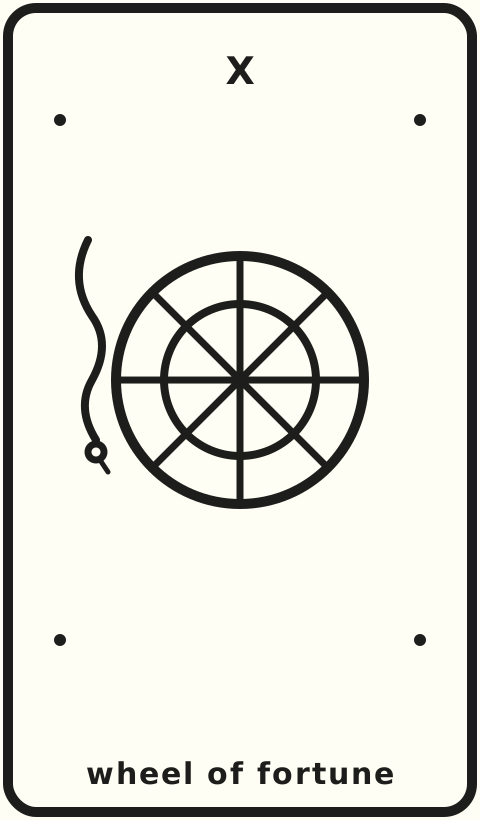
Every tarot deck contains one card that is not about you. The Wheel of Fortune turns whether the querent is wise or foolish, prepared or not; Waite calls it the emblem of “the perpetual motion of a fluidic universe” (Pictorial Key, 1911). It is the card of the fact that most of what happens to you is not addressed to you.
Two traditions took that fact more seriously than any others, and they reached instructively different conclusions.
The Stoic answer: shrink the self to what it controls
Epictetus — born a slave, which lends his position some authority — opens the Enchiridion with the most consequential sentence in Stoicism: “Some things are in our control and others not. Things in our control are opinion, pursuit, desire, aversion… Things not in our control are body, property, reputation, command” (Ench. 1, Long’s translation).
Everything the wheel touches — health, wealth, standing, outcomes — falls in the second column. The Stoic response is not resignation but a reallocation of identity: you are not the rim of the wheel, rising and falling; you are the judging faculty at the hub, which the turning cannot reach unless you hand it the keys. “Men are disturbed not by the things which happen, but by the opinions about the things” (Ench. 5).
Marcus Aurelius pushes it to affirmation: the emperor who could command everything except events writes to himself, “Everything harmonizes with me, which is harmonious to thee, O Universe” (Meditations 4.23, Long). Later tradition names this amor fati — not merely enduring the turn of the wheel but willing it, as one wills the plot of a story one loves.
The Gita’s answer: act fully, own nothing
The Bhagavad Gita stages the problem at its extreme: Arjuna on a battlefield, obligated to act in a situation he did not choose and cannot control, paralyzed by the scale of consequences. Krishna’s reply, chapter 2 verse 47, is the Gita’s most quoted line for good reason: “Thy right is to the work, but never to its fruits” (after Besant’s translation).
This is not the Stoic move. Epictetus withdraws the self from outcomes by judgment; Krishna keeps the self fully in the action while surrendering the ownership of results — karma yoga, the discipline of consecrated action. The archer draws with total commitment; where the arrow lands belongs to the wheel. Verse 2.50 compresses it: “Yoga is skill in action.” Skill — not luck, not outcome. The quality of the deed is the only part of the deed you keep.
The practical difference is real. A Stoic before a decisive interview rehearses indifference to rejection; a karma yogi prepares flawlessly and releases the verdict at the door. Both walk in free. They freed different hands.
What the card is not
The Wheel of Fortune is regularly read as “luck is coming” — the slot-machine interpretation. The card’s own iconography argues otherwise: the medieval rota fortunae, which the tarot inherited (Dummett traces the lineage in The Game of Tarot, 1980), shows figures at every station — rising, enthroned, falling, crushed — simultaneously. The wheel does not promise your position; it discloses the mechanism. Boethius, whose Consolation of Philosophy fixed the image for the Middle Ages, has Fortune herself say it: “I turn the wheel that spins. I delight to see the high come down and the low ascend.”
The reading that respects the sources is therefore never “good times ahead.” It is: a turning is in progress; your position is temporary in both directions; the only stable asset on the table is how you act at your current station.
Reading it in practice
Upright, the Wheel asks for Epictetus’ inventory — two columns, ruthlessly honest: what here is mine, what is the wheel’s? Most anguish, examined, turns out to be filed in the wrong column. Reversed, it typically marks resistance to a turn already underway: clinging to a phase the wheel has finished with, or blaming the mechanism for the grip.
Our deck’s question for the card: if you knew the outcome was not yours to keep, how would you act differently today?
Sources. Epictetus, Enchiridion 1 and 5, trans. after George Long (public domain). Marcus Aurelius, Meditations 4.23, trans. Long (public domain). Bhagavad Gita 2.47, 2.50, trans. after Annie Besant (1895) and Edwin Arnold (1885), public domain. Boethius, The Consolation of Philosophy, Book II. A.E. Waite, The Pictorial Key to the Tarot (1911). Michael Dummett, The Game of Tarot (1980) — cited for iconographic history.
Try the reading tool: the three-card spread (past · present · becoming) is the Wheel’s native habitat — every interpretation cited to its source.